On 24 May, in historical Jazlovets, within the walls of the Monastery of the Sisters of the Immaculate Conception, the ‘Jazzloviec Festival MMXXV’ concluded with a magnificent concert of Renaissance music and song.

Due to unexpected May weather, the musical performance—which was originally scheduled, according to the festival programme, to take place in the ruins of the Church of the Assumption—was moved under the roof of the Monastery. Indeed, the church in Jazlovets has been without a roof for several decades and continues to deteriorate rapidly.
As the organisers of ‘Jazzloviec Festival MMXXV’ reported, their initiative aims to promote Renaissance music and jazz: “The Jazzloviec Festival combines two extreme worlds of music—the Renaissance and jazz, all thanks to an extraordinary artefact: the headstone of the Renaissance composer Mikołaj Gomułka, located in the ruins of the church…” Besides the music of Gomułka, the ‘Jazzloviec Festival MMXXV’ programme included melodies by other 16th and 17th-century composers: Piotr Żelechowski, Jan of Lublin, and others.
However, the festival is specifically dedicated to Him, Mikołaj Gomułka (Mikolaj Gomolka, 1535–1609?)—a prominent musician, singer, and composer of the Renaissance era. The Maestro’s principal and best-known musical work is a collection of 150 melodies for the Psalms of David, translated into Polish by Jan Kochanowski. The collection was published in Kraków in 1580 (original title: “Melodije na psalterz polski, przez Mikolaja Gomolke vczynione”). This work is considered perhaps the most significant monument of Polish musical culture from the Renaissance.
The late 16th-century Church of the Assumption in Jazlovets indeed contains Gomułka’s headstone. On the gravestone, built into the wall, a carved bas-relief survives, as well as an epitaph stating: “This stone marks the grave of Gomułka, whom cruel death took while on the road. All the musicians and skilled craftsmen wept, and the houses of the wealthy grew silent…”

While Mikołaj Gomułka’s biography still contains certain contradictions, it is worth noting that the fact of the maestro’s death and his burial in Jazlovets in 1609 is confirmed in the work “Pamiatki Jazlowieckie” (Memoirs of Jazlovets) by the famous 19th-century historian and Dominican friar Sadok Wincenty Barącz.
Yet historic Jazlovets is, of course, more than just the artefact of a gravestone in the wall of the oldest Catholic church here in the Warm Podillia. Jazlovets—even today, despite the countless losses to its historical and cultural heritage in the last century—is a special, unique, and magical world.
One foreign publication on the history of Jazlovets is titled “The Town Lost in History”. Indeed, a detailed and objective history of Jazlovets in Ukraine has yet to be written. Moreover, for a long time, its history was deliberately obscured—beginning with its historical name, which was changed to Yablunivka. Thus, the town truly spent far too long lost in oblivion and provincial ignorance.
Currently, the greatest attraction for tourists is the 18th-century Poniatowski Palace, which houses the Monastery of the Sisters of the Immaculate Conception, founded here in 1862 by Marcelina Darowska.
During one of his first visits here, the author of these lines left an entry in the guestbook expressing confidence that the revival of historical Jazlovets would begin exactly here, at the monastery.
Indeed, this process has already begun and has been ongoing for some years. in 1996, Pope John Paul II beatified Marcelina Darowska. and as early as 1997, the Monastery of the Sisters of the Immaculate Conception was restored in Jazlovets. in 1999, the Metropolitan of the Roman Catholic Church in Lviv, Cardinal Marian Jaworski, proclaimed the sisters’ burial chapel as the Sanctuary of Blessed Marcelina Darowska. today, therefore, the Sanctuary in Jazlovets is one of the Christian holy sites of the Ternopil region, alongside the Marian Spiritual Centre in Zarvanytsya, the Holy Dormition Lavra in Pochaiv, and the Sanctuary of Our Lady of the Holy Rosary in Chortkiv.
Over the last twenty-eight years, the Monastery of the Immaculate Conception Sisters has performed, without exaggeration, colossal work on the restoration and upkeep of the entire monastery complex: the palace, the park, and the burial chapel where the deceased sisters rest.

The traditions of spiritual upbringing and the education of youth established by Mother Marcelina are actively developed here. Every year, the monastery organises Christian retreats and educational events that bring together hundreds of children from all regions of Ukraine and abroad. After the start of the RF’s armed aggression against Ukraine, hundreds of refugee families with children found shelter in the monastery for three years.
Thus, the monastery in Jazlovets today no longer appears “lost in history” or closed off. It has been revitalised in the modern era, living among people and for people.
Against this backdrop, the Church of the Assumption in Jazlovets appears particularly cheerless. Its carved Renaissance portals still remember the years of the Ottoman invasion. Miraculously, the church survived two world wars despite the terrible destruction around it. But the era of militant Bolshevik atheism proved fatal for the temple. for half a century, it has stood without a roof, and its Gothic vaults have now almost entirely collapsed. as yet, there is no word even of preserving the historic structure.
In July 2008, a group of visiting eccentric individuals attempted to do at least something to rescue the church and draw attention to its condition. Over two working days, we cut back the elderberry and nettle thickets inside the temple, carried out all the floor beams that had long since fallen, collected rubbish left by vandals, wheeled out several cubic metres of lime plaster that had been crumbling from the walls for years, and paved the area around Maestro Gomułka’s headstone with stone tiles… At the conclusion of the *toloka* (community work day), we locked the church doors, which had stood open to the four winds for years.
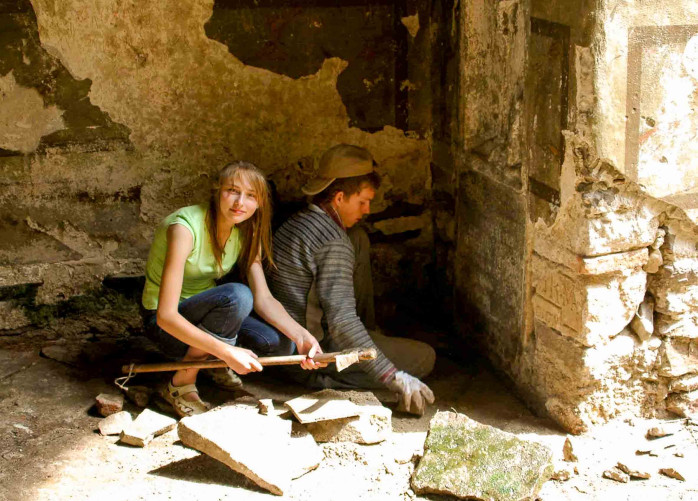
Here are the participants of that unforgettable volunteer toloka: Khrystyna Pohoretska, student (Chortkiv); Bohdan Makhomet, student (Chortkiv); Nadiya Samardak, social activist (Chernihiv); Volodymyr Moroz, journalist (Ternopil); Ihor Sirenko, biologist, Head of the Council of the National Ecological Centre of Ukraine (Kyiv); and Alexander Stepanenko, physician, Chairman of the Board of EGO ‘Green World’ (Chortkiv).

Saying farewell to friends back then, one of us remarked: “I believe that one day Mikołaj Gomułka’s music will sound in this church once again!”…
* * *
And therefore, the appearance of the Jazzloviec festival last year was like the first swallow, bringing the news that someone still lives by this faith! That we are a step closer to the day when David's Psalms, set to music by Maestro Gomułka, will be heard not only in Kraków and Warsaw, but also in Jazlovets! And not only on the threshold of the Assumption Church, but under its new roof!
This year, on 23 May, the ‘Jazzloviec Festival MMXXV’ presented a jazz concert by the Ukrainian family band ‘ShekBand: Jazz Family Trio’ featuring: Anna Shekera — piano, harp; Artem Shekera — double bass; and Maksym Shekera — drums.

And the following day, ‘Jazzloviec Festival’ treated the audience to music and song of the Renaissance era in an exquisite performance by the Ukrainian-Polish quartet ‘Gomolca Ensemble’. It included: Viktoriya Oskroba — soprano; Lyudmyla-Aisata Bolli — alto; Krzysztof Czupiński-Świątek — tenor; and Stanisław Łopuszyński — bass, harpsichord. Our heartfelt thanks to them for this magnificent gift!
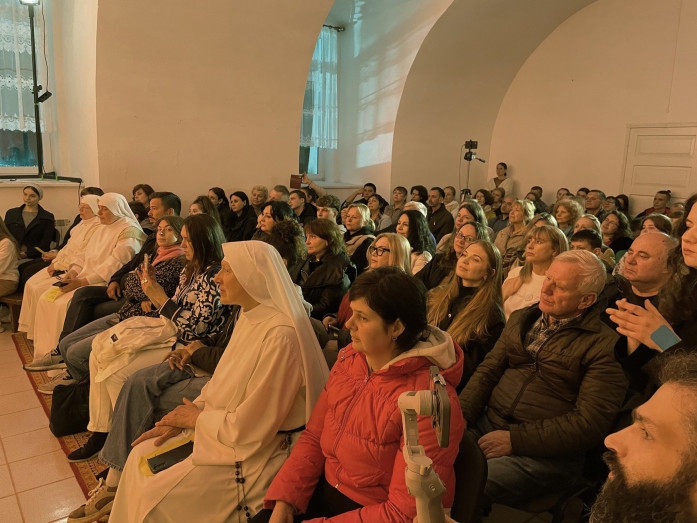
Organisers of the ‘Jazzloviec Festival’ included: the Consulate General of the Republic of Poland in Lutsk, the Jan Olszewski Foundation for Aid to Poles in the East, the Monastery of the Sisters of the Immaculate Conception of the Blessed Virgin Mary in Jazlovets, and the Buchach City Council.
It was noted that the ‘Jazzloviec Festival’ took place under the honorary patronage of Archbishop Mieczysław Mokrzycki, Metropolitan of Lviv. The festival was also supported by the Polish Institute in Kyiv.
Furthermore, at the end of that musical performance, I noticed a short, elderly woman in the hall among the many guests. No one welcomed her as an honoured guest. Her name was not spoken, though…
In childhood, her parents named her Janina and baptised her in the Church of the Assumption of the Virgin Mary. throughout her entire life, that woman remained faithful to her Church. for many years now, she has come to it alone in prayer. This can be observed every Sunday: in rain and snow, in frost and heat. from spring to late autumn she is here—with flowers. she tidies up near the altar she constructed herself from bricks, lights candles, kneels, and addresses God in prayer.

Janina’s prayer cannot fail to be heard and rewarded. surely everything She asks for will come to pass.
In my view, this modest lady, alongside the Immaculate Conception Sisters, embodies our faith in the revival of Jazlovets, the reconstruction of the Temple, and the possibility of brotherhood and peace among men.