The opening of the 22nd Travelling Docudays UA International Human Rights Documentary Film Festival in the Ternopil region took place on 13 October at the Zalishchyky State Gymnasium. The choice of this educational institution was not coincidental – according to the results of the external independent evaluation of graduates’ knowledge in 2025, the gymnasium demonstrated the best result in the region and the fourth-best in Ukraine. In previous years, the results of external testing here were also very high. Thus, we have cause to be proud of the Zalishchyky Gymnasium and another excuse to visit.
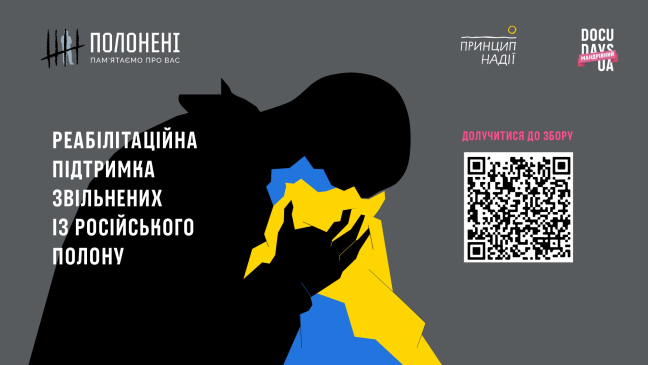
The meeting with senior gymnasium students and their teachers began with an introduction and a request to share the initiative of this year’s festival ambassador, Maksym Butkevych, and the human rights organisation he founded, ‘The Principle of Hope’. This refers to a charitable fundraiser for the rehabilitation of Ukrainians – both military and civilians – released from Russian captivity.
Furthermore, as the main theme of Docudays UA—2025 is the concept of ‘Rare Resource’, we collectively sought answers to the question: what is the most valuable and rarest resource in our land? The discussion was moderated by Vasyl Hryhorovych Dyakiv, a Merited Teacher of Ukraine and winner of the national ‘Global Teacher Prize Ukraine’ award.

Perhaps it is modern, high-tech types of weapons that will allow us to endure in the war, protect our cities and energy facilities from shelling, and not lose as many of our soldiers’ lives as we are currently losing? Or perhaps it is truthful information about the course of the war? Might medical assistance for our military on the front line – where, due to the logistical blockade, no sanitary transport can reach – also be a rare and particularly valuable resource?
Could such a resource be social housing for millions of refugees from frontline regions, the acute shortage of which is forcing them to leave Ukraine today? And who knows if they will return tomorrow?
Is it perhaps effective diplomacy on the international stage that would allow Ukraine to increase its circle of allies and partners, rather than allowing the enemy’s partners to multiply?
It seems it is high time we realised how valuable elementary means of survival have become in many regions of Ukraine. For example, water, which has been disappearing from rivers, springs, wells, and even deep boreholes for years? Ultimately, the Zalishchyky gymnasium students have the opportunity almost every year to observe signs of the Dniester drying up – the river on whose banks their town stands.
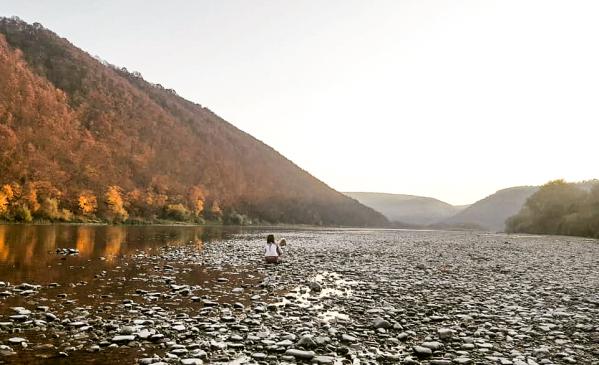
Should we not consider the last undisturbed natural landscapes in the Carpathians, Polissya, Volyn, and the Black Sea steppes to be rare and endangered? They are increasingly retreating before the relentless onslaught of the plough and pesticides, logging, mining, the construction of mega-resorts, suburban villas, and wind farms...
Is economic freedom not the resource that, for some reason, shrinks year after year – in a country that currently ranks 150th out of 165 countries in the ‘Economic Freedom of the World 2024’ index, alongside Burundi (149th), Ethiopia (148th), Iraq (147th), Chad (151st), and Congo (152nd) in the rankings?
Perhaps it is also quality education that would allow for the revival of high-tech industrial production in Ukraine, the creation of renewable energy sources and sustainable transport systems, and the reconstruction of destroyed towns and villages? From this point of view, the sound knowledge that Zalishchyky Gymnasium provides its students is also a valuable resource.
Should we not consider the capacity for effective communication between the government and the community – both within society and externally – a rare resource? Does the government understand this need? Before the elections, they promised us they would listen to every citizen, yet recently public dialogue has dwindled to the primitive monologues of its leaders, which everyone has long since grown tired of. Though, let us be frank: sometimes it feels as if ordinary citizens do not understand one another even when speaking the same language. What can be said when linguistic, geographical, and civilisational barriers arise between people!Finally, what can be said about the value of artificial electronic intelligence today and tomorrow?
Or perhaps the most precious resource is TIME? Each consecutive day of the war, which destroys Ukraine, takes away its children, and diminishes its chances for long-term survival?...
We have somehow become accustomed – especially over eleven years of war – to the fact that from the perspective of an economist, a statistician, or a political or military leader, people are also considered a resource: demographic, labour, or mobilisational. That is, as an impersonal mass, personnel, a population, a human crowd.
The vision of a humanist, philosopher, poet, or human rights activist, which singles out the INDIVIDUAL HUMAN PERSONALITY from this crowd, has noticeably yielded to the general mainstream. We recall the constitutional maxim declaring: ‘A PERSON, their life and health, honour and dignity, inviolability and security are recognised in Ukraine as the HIGHEST SOCIAL VALUE’ less and less frequently.
The highest social value and a resource – are they truly the same thing?
Thus, we invited the senior students to find synonyms for the word ‘resources’ to define the concept more broadly. Various options were heard: means, potential, opportunities, funds, capital, personnel, sources, reserves, materials... Finally, a young man from the back row raised his hand and shouted: ‘USEFUL THINGS!’ And with that, he seemed to have ‘hit the bullseye’, providing a universal formulation for different types of resources: natural, technical, informational, and financial. Indeed, they are all useful; they are all necessary for survival and sustainable development. We cannot do without them!
Yet a Human Being, any one of us, does not want to be just a ‘USEFUL THING’! A person resists the state that predominantly sees them this way and acts in accordance with that vision! Or they leave such a country and do not return!
If we imagine Ukraine as a republic of free citizens (from RES PUBLICA – THE COMMON CAUSE), then we must foster an attitude towards the Individual as the HIGHEST SOCIAL VALUE! As a free PERSONALITY. For only in such a capacity can Ukraine defeat the aggressor in a war, which outmatches it many times over in RESOURCES!
At the conclusion of this discussion, a questionnaire was distributed among the students with the question: ‘What do you consider the most valuable and rarest resources of our region, the Podillian Dniester area?’ They were asked to choose three options closest to their vision. As a result, we received 72 completed questionnaires. What does the scale of the region’s most valuable and rarest resources look like? Picturesque landscapes – 35 marks; historical and architectural monuments – 22; fertile land – 21; nature reserve facilities – 20; sources of clean drinking water – 14; forests – 14; hard-working people – 11; unique climate – 10; sports facilities – 10; entertainment sphere – 8; educational institutions – 7; medical facilities – 7; artistic ensembles – 6; religious shrines – 4; agricultural enterprises – 3; mineral deposits – 3; museums – 2; comfortable housing – 2; libraries – 1... In the ‘OTHER’ column, two entries appeared: ‘clean air without car exhausts’ and ‘water rafting on the Dniester’.
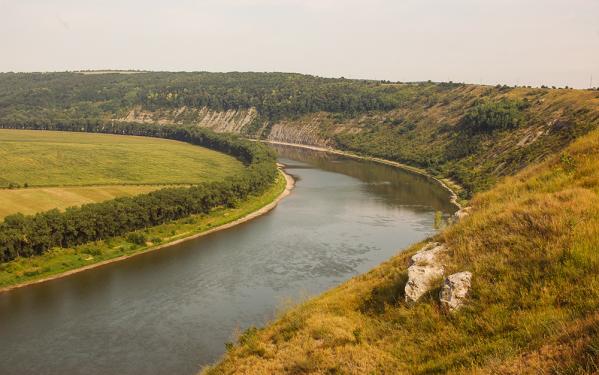
If the results of this survey can be generalised, the highest priority was given to items that can be reduced to the concept of ‘natural and historical-cultural heritage’. I suspect that, in addition to their own educational institution, the activities of the Dniester Canyon National Nature Park, whose central headquarters is in Zalishchyky and which recently celebrated its 15th anniversary, contribute to the formation of such views among the students.
Indeed, the beauty of the Dniester Canyon landscapes – one of the ‘Seven Natural Wonders of Ukraine’ – speaks for itself.
But what about the films? On the festival’s opening day, we showed three short films to three age groups of students. They are truly wonderful and are also our ‘rare resource’, as currently, they can only be viewed at Docudays UA.
Each film provoked a lively discussion. The first, ‘How Was Your Summer Vacation?’ is a chronicle of the first of September – an ostensibly ordinary event that takes place in all schools according to a standard script, accompanied by similar stories about the summer. But despite the camera recording the first school day in various regions of Ukraine, the impression is of children of a large and diverse, yet UNITED COUNTRY. All of them experience the trauma of war in their own way and long for peace. All of them have matured unexpectedly over the years of war, and some of their words are simply striking. For example: ‘For me, there is no victory, as we have lost so many people, territories, and human homes – so much in our culture that I simply will not be able to celebrate it...’
The day’s programme continued with the screening of the animated film ‘In the Heart of the Valley – Song’ directed by Nathan Fagan – no exaggeration, a masterpiece of the short film genre. The author presented the story of three convicts in the USA sentenced to many years in solitary confinement. That is, they were punished not only by deprivation of liberty but also by extreme loneliness. Yet human communication is one of the prerequisites for a full life. It is one of the greatest values in our lives. A human always needs another human. Parents – to give life to a Child. A man needs a woman so that this life might continue. The strong need the weaker to help them. The educated need those to whom they can pass on their wisdom. Anyone needs another with whom they can share their bread. Their joy. Their pain. Their thoughts – and it is not so important whether that other person agrees with you. What matters is that in this communication, you gain the opportunity to understand yourself better.

This film further proves that documentary cinema can be highly artistic, and that even a ‘cartoon’ can be filled with deep and important meaning.
Finally, there was ‘Last Song from Kabul’ – a poignant story that strikes a chord and resonates among Ukrainians, as many of us have also been forced to leave our homes due to the war.
* * *
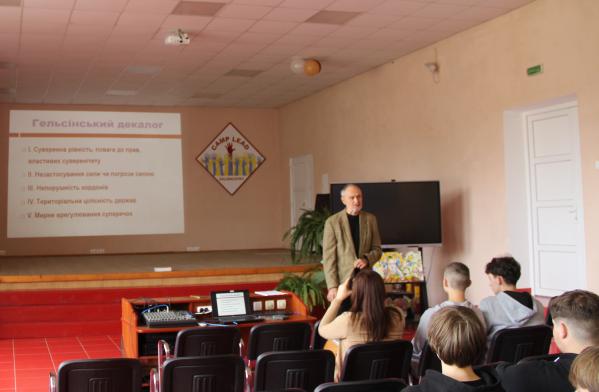
The opening programme of the Travelling Festival was supplemented by a special event – a presentation by Oleksandr Stepanenko titled ‘50 Years of the Helsinki Accords: History, Today, Prospects’. It was presented on the occasion of the 50th anniversary of the adoption of the Helsinki Final Act of the Conference on Security and Co-operation in Europe.
For the fourth consecutive year, Ukraine has been making terrible sacrifices in the war unleashed against it by the Kremlin dictatorship. Naturally, we long for peace. But it must be a just peace – one that does not destroy the foundations of international law and does not leave unpunished the crimes of aggression, genocide, crimes against humanity, and war crimes.
From this point of view, it seems obvious that the ‘Helsinki Decalogue’ – those ten principles for maintaining international legal order formulated 50 years ago – remains relevant today. All countries are sovereign and equal in rights; their borders are inviolable. The use of military force or the threat of force in international relations is unacceptable; disputes between countries must be resolved by peaceful means. Interference in the internal affairs of states is impermissible. At the same time, states commit to respecting human rights and fundamental freedoms, including freedom of thought, conscience, religion, and belief.
These principles must be reaffirmed by all European countries under new historical conditions in a new international agreement. Such an agreement would re-establish legal guarantees for international security, cooperation between countries, and human rights.
Thus, it is time to adopt a kind of ‘Helsinki for the 21st Century’ pact and create effective institutions capable of monitoring its implementation. Ukraine, which has perhaps suffered most from violations of international law and armed aggression, should be among the most active initiators of this process.
* * *
Oleksandr Stepanenko, Coordinator of the Docudays UA International Travelling Human Rights Documentary Film Festival in the Ternopil region